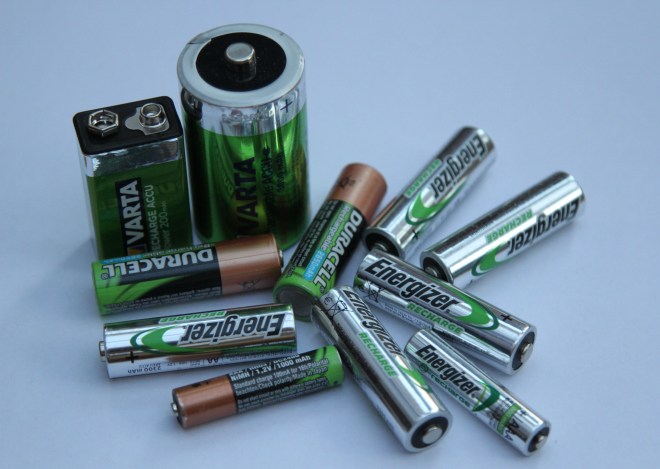
Does it make sense to buy rechargeable batteries? Don’t they cost more? Don’t they lose their charge more rapidly than ordinary ones? Don’t we need to buy a special battery charger for them too? So is it really worth it?
Most modern household batteries are Alkaline batteries. These are single-use batteries containing zinc, manganese dioxide and potassium hydroxide. Older batteries and more specialist batteries may contain materials which cause long-term environmental risk when discarded. For that reason, all batteries in Europe are required to be collected separately and should not be put into general household waste. To reduce the quantity of batteries requiring waste treatment we can buy fewer of them. We can do this easily by choosing rechargeable batteries which significantly reduces our consumption of materials. Yes, ultimately also rechargeable batteries will need replacing and recycling but we should be able to get hundreds of uses out of them before this point.
The Economic Case
| One-time use battery option | Rechargeable battery option |
|---|---|
Example uses a premium brand Alkaline AA battery | Example uses a premium brand NiMH (nickel metal hydride) AA battery (labelled as “Stay Charged” or “Pre-Charged” or “Ready-to-Use”) and branded charger |
| 1.5 V Alkaline AA | 1.2 V 2300 mAh NiMH AA |
| Cost of purchase = £4 (pack of 4) | Cost of purchase = £12 (pack of 4) |
| Cost of battery charger = £15 | |
| Example uses 4 AA batteries | Example uses 4 AA batteries |
| Life in example application = 4 months | Life in example application = 3 months |
| Cost to recharge with 40 p/kWh electricity price. Energy used to recharge one = 2300 mAh * 1.2 V / 80% = 3 Wh (recharge efficiencies are often better than 80%) = 0.0035 kWh Cost = 0.14 p (yes, fractions of pence or £0.0014) Cost to recharge 4 = £0.0056 | |
| Over 1 year cost is Cost of purchase x 3 = £4 x 3 = £12 | Over 1 year cost is Cost of purchase x 1 + Cost of charger x 1 + Cost to recharge x 4 = £12 + £15 + 4 x £0.0056 = £27.02 |
| Over 3 years cost is 3 x £12 = £36 | Over 3 years cost is £27 + 3 x £0.0224 = £27.07 |
The time taken to break-even may be very quick if you use lots of batteries. Although in the table the life on a single charge looks worse, this is often not the case. The performance of NiMH batteries may be even better than Alkaline in high drain applications like in a camera flash (this is because high drain devices deplete the capacity of Alkaline batteries by as much as half, whereas NiMH batteries don’t suffer from these capacity loss issues). Although the voltage of NiMH batteries is 1.2 V compared to 1.5 V for Alkaline batteries, many electronic devices are designed to cope with the expected battery voltage reduction of Alkaline batteries as they discharge from 1.5 V to around 1.0 V. So NiMH batteries are almost always interchangeable with Alkaline batteries in modern devices. Furthermore, NiMH batteries don’t show a similar voltage reduction and stay around 1.2 V until nearly completely discharged. Newer NiMH batteries sold with the description “Stay Charged” or “Pre-Charged” or “Ready-to-Use” use a slightly different internal design that limits the self-discharge rate. This makes them better for low drain devices than the standard NiMH batteries, even if their shelf life after a charge is not as good as the 10 years shelf life of the single-use premium “long-life” Alkaline battery. Of course it is easy to recover the charge of a NiMH battery by simply recharging it!
The Environmental Case
About 4 billion Alkaline batteries are produced and used every year [1]. Alkaline batteries are the most popular household battery. If these were replaced with NiMH batteries then our total consumption of batteries would reduce. Most manufacturers claim at least 500 recharge cycles with many claiming over 1500 recharge cycles. So our 4 billion figure could ultimately reduce to 8 million!
Alkaline batteries can be recycled but this appears not to be routine at the moment (energy savings and reduction in carbon dioxide emissions compared to using mineral ores are expected if recycling becomes more widespread [1]). The recycled content of NiMH batteries appears to be increasing with one leading premium brand now claiming they use 15% recycled materials, up from zero a few years back.
Finally, you might have encountered leaks with Alkaline batteries which look like a white crusty deposit around the battery (often found in devices that have been left around for a long time). This would be a leak of potassium hydroxide and this is an irritant so be careful when handling. It can also irrepairably damage electronic circuits. NiMH batteries are much less likely to leak. So using NiMH batteries can help reduce electronic waste too.
[1] Hamade et al., “Life Cycle Analysis of AA Alkaline Batteries”, Procedia Manufacturing, Vol. 43, 2020, https://doi.org/10.1016/j.promfg.2020.02.193
 Living Laudato Si'