
Bottled water might be the safest and healthiest choice for some people in locations where tap water is not potable (not drinking water) or has a foul taste. In many regions, and in most of the UK, municipal treated water (tap water) is perfectly fine and is safe to drink. Exceptions to this are where the local supply pipes or the pipes in the property are old, for example if they are old lead pipes. In those cases filtered water or bottled water may be safer. If in doubt, check with your local water supply company or look for their quality information on their website.
Here we check the cost, carbon intensity and waste implications for a typical disposable bottle of water and compare to tap water (using UK data):
| Bottled water (Note 1) | Tap water | |
|---|---|---|
| Cost | Around £1 per L | £0.002 per L (Note 2) |
| Carbon Emissions | 350 gCO2e per L (Note 3) | 0.15 gCO2e per L (Note 4) |
| Waste | 40 g PET per L (Note 5) | None (Note 6) |
| Chemical analysis | See label | Example |
Notes:
- Assuming still water. Carbonated (or sparkling water) includes additional carbon dioxide which is often fossil-derived and contributes to additional carbon dioxide emissions.
- Using water costs for the UK Severn Trent water area (Midlands) – 180 p per cubic metre = £1.8 per 1000 litres or 0.18 p per litre.
- Carbon intensity for bottled water. Emissions come from power and operations of the bottling plants, packaging and supply chains, and transport and delivery. UK government consumption emissions table from 2017 showed that greenhouse gas emissions for mineral or spring water was 0.537 kgCO2e per £. This was derived from research data from the University of Leeds and previously published on the UK government website. Taking account of inflation of 24% since 2017 and recognising that some of the emission profile was falling with the UK electricity emissions reduction, a value in the range 0.3 kgCO2e to 0.4 kgCO2e per L is expected (carbon intensity of bottled water in 2001 was 1.63 kgCO2e per £ in 2001, according to this research).
- Published data for water supply from the UK government (see here). 0.15311 kgCO2e per cubic metre = 0.15311 gCO2e per litre
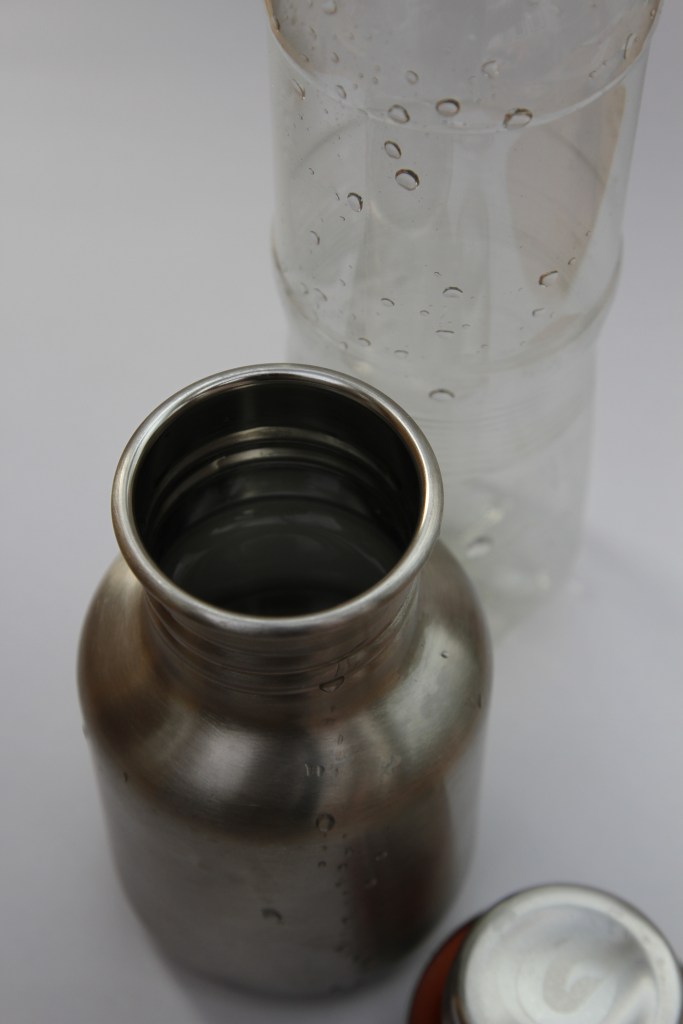
- Assuming 1 L bottle. Smaller bottles may use more plastic per unit volume. Most water bottles are made of PET plastic (polyethylene terephthalate) and this is readily recycled. It is easy to weigh the amount of plastic used in a water bottle using kitchen scales. Here we assume it is 40 g. The UK government emissions figures for recycling PET (also here) suggest 6.41 kgCO2e/tonne or for landfill this is 8.88 kgCO2e/tonne. It is perhaps interesting to note that PET recycling rates are among the highest now for plastics and there are an increasing number of recycled PET bottles being used (just look at the packaging or recycling label may show rPET). An emerging area of research interest is in the level of toxicity in repeated recycling which may be of concern if used in direct contact with foodstuffs or drinks (repeated high temperature treatments on a complex number of different additives is thought to contribute to this). In any case the use of returnable glass bottles or re-usable stainless steel flasks appears to be environmentally beneficial with health benefits too.
- Not including washing up cup used to drink the water.
 Living Laudato Si'