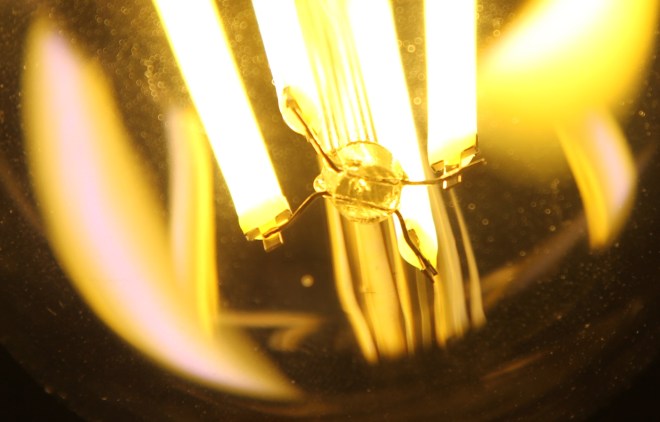
With the advent of low energy light bulbs, the pressure to switch off lights has substantially reduced. Notices reminding us to switch off lights in schools and offices are not as common as they once were. Do you still switch off lights when you exit a room? Even though the cost of leaving them on is reduced, we ought to conserve energy and switch them off whever possible. The need for energy conservation has not gone away and it is still one of the easiest actions to remember to do which will save a little money too (even more so in a world of increasing energy prices).
Another top tip is to put your lowest energy bulbs in the areas you regularly use or where you need the light for the longest periods.
| Type | Power |
|---|---|
| CFL (Compact Fluorescent Lamp) | ~20 W |
| LED (Light Emitting Diode) | ~12 W |
| Latest LED low energy | ~7 W |

STEM challenge (suitable for 9-12 year olds and anyone curious about the top tip above): arranging our light bulbs around the house. We have 3 light fittings. One is used for 8 hours per day, another is used for 4 hours per day and the last one is used for 2 hours per day. We have 4 bulbs to choose from: an old incandescent 100 W bulb and the three in the table above (20 W CFL, 12 W LED and 7 W high efficiency LED). Arrange the bulbs to reduce our annual energy bill. How many kWh per year does your arrangement use and if electricity prices are 27 p/kWh (the expected cost of electricity from April to June 2025 from https://www.ofgem.gov.uk/energy-price-cap), what is the annual cost? What is the worst combination and how much does your best arrangement save over the worst arrangement?
STEM Hint: multiply the W by the hours to get Wh per day. 1 kWh = 1000 Wh. There are 365 days this year.

STEM Answer: Put the 7 W bulb into the light we used most (8 h), the 12 W bulb into the next most used light (4 h) and the 20 W bulb in the least used light (2 h), giving 7×8+12×4+20×2 = 144 Wh. 52.6 kWh per year. 27×52.6 = 1419 p = £14.19 per year. The worst combination is 100×8+20×4+12×2 = 904 Wh (330 kWh per year, £89.09, some £74.90 more expensive!)
 Living Laudato Si'