The Fair Trade movement is rooted in social justice and giving dignity to those who grow and harvest crops for global export. Laudato Si’ dedicates a whole chapter to Integral Ecology: an ecology that “respects its human and social dimensions” (LS 137). The principle of the common good is an established part of Catholic Social Teaching. “Underlying the principle of the common good is respect for the human person as such, endowed with basic and inalienable rights ordered to his or her integral development” (LS 157). “In the present condition of global society, where injustices abound and growing numbers of people are deprived of basic human rights and considered expendable, the principle of the common good immediately becomes, logically and inevitably, a summons to solidarity and a preferential option for the poorest of our brothers and sisters” (LS 158) and it goes on to describe it as an “ethical imperative”. Thus we are called to go beyond words in our support of the poorest: through economic means we can provide fair wages and good working conditions to them. The easiest way of doing this is to seek out and purchase Fair Trade products whenever the choice is available.
It is tempting to shy away from Fair Trade because it is perceived as an expensive option. However, even if it does cost more, it still is an “ethical imperative”. But how much more does going Fair Trade really cost? A couple of years back we calculated the ingredients only cost (excluding wastage) of going from the cheapest tea and coffee to Fair Trade tea or coffee for the parish. The results showed that the additional cost of Fair Trade was surprisingly small. Fair trade tea was particularly affordable because when making tea for a community, only five or six tea bags are kept in the tea pot making tea for twenty plus people. Coffee was made per cup using instant coffee granules. So the coffee cost is similar to the at-home cost, but the tea cost is lower (unless you save your tea bag for your next cup, as some people do).

So next time you are tempted to pass by the Fair Trade products because of their cost, think instead that the tiny cost increase per cup is making a real difference to some of the poorest people in our interconnected world.

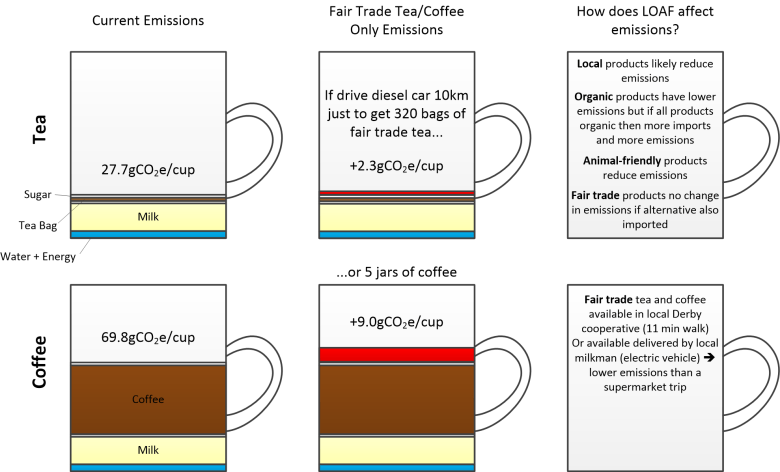
Postscript: what about emissions if you have to go further to buy Fair Trade?

 Living Laudato Si'