
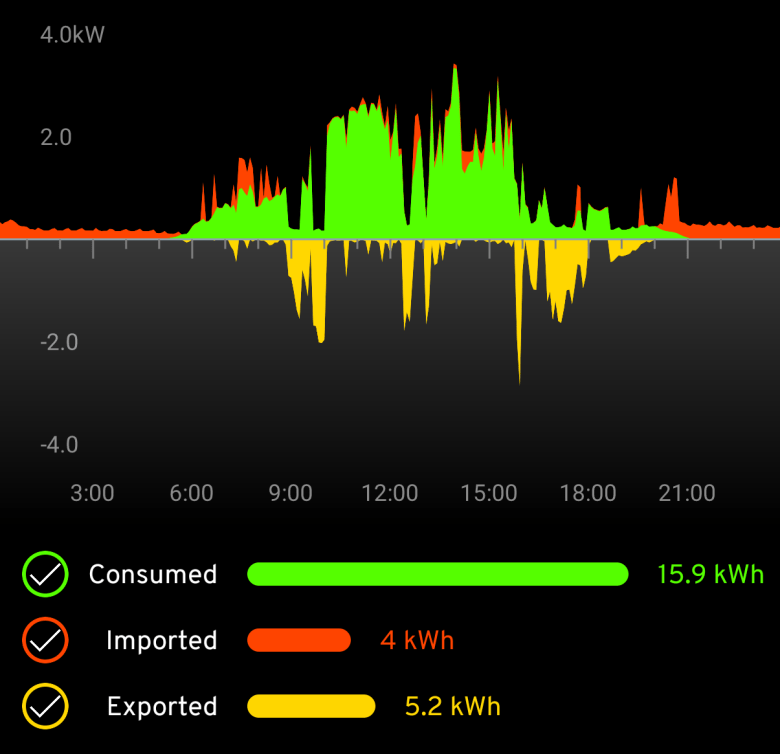
Solar power generates electricity during the day. Often most electricity is used in the early morning (e.g. kettle, toaster, electric shower, iron, …) and in the evening (e.g. oven, TV, washer/dryer, dishwasher, …) and not so much during the middle of the day. Could we shift our energy usage to coincide with the times of peak solar energy production?
Many new solar installations come with a battery so the need to change behaviours is not immediately needed. However there may be minor benefits for considering this even with a battery*.
(*) Battery life may be extended slightly by reducing the number of charge/discharge cycles and especially by the number of deep discharge cycles. In addition, some small power losses are inevitable when charging and discharging the battery. There may also be limits to the power (kW limit) and total energy (kWh capacity) of the battery (see battery specifications) and this can reduce the amount of electricity stored from the solar panels at peak generation times.
In a strange sort of way, it is somewhat reassuring to be able to move power usage to align with the sun’s light and heat. It feels more connected to the natural world, living a life more to the rhythm of the day, even if it is a modern take on it.
Not having a dedicated battery myself, it is satisfying to shift usage to when the sun is shining. Some of the benefit is automatically achieved through the use of diverters (hot water and car charging), some through timers on equipment (dishwasher, washing machine, heat pump), and the rest by manual intervention.
Whilst we encourage going electric on this website (to reduce emissions and thereby reduce the impact on climate change), there are environmental benefits for not using too many batteries and by shifting electricity demand where possible. Ultimately, moving electrical demand to when renewables are available will save resources and critical mineral use by reducing the total installed battery capacity the world really needs. Some level of demand-side variation to match intermittent renewable output is likely to be required in the future.
 Living Laudato Si'