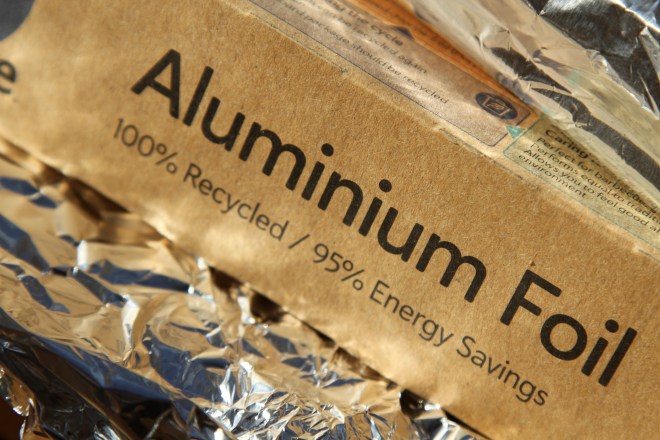
If there’s one material that stands out as a lighthouse for the cause of recycling, it must be aluminium.
Aluminium requires a vast amount of energy to extract and cast. Chemically, it prefers to stay as an ore. The advent of electrochemistry was the technological leap that transformed the metal from being a curiosity of the super rich two hundred years ago to an everyday metal.
Today, large quantities of electricity are needed to make aluminium metal and, depending on where that electricity is sourced from, this could lead to a wide range of emissions.
Bauxite is a fairly plentiful ore containing aluminium minerals. First this ore is processed to extract alumina (aluminium oxide) using the Bayer process: the ore is crushed and heated to just under 200°C in a pressure vessel with sodium hydroxide (caustic soda), filtered to isolate sodium aluminate (with red mud or bauxite residue as the main waste product) and then this is cooled and crystallised using water, and finally heated to 1200°C in a rotary kiln to leave alumina. Typically around 2 or 3 tonnes of bauxite would need to be processed to make 1 tonne of alumina, depending on how rich the ore is. Each tonne could need around 2 to 5 MWh of energy (mostly as heat). The waste from this process (red mud) is a significant environmental hazard as a result of its high pH (high alkalinity – very caustic) and its shear volume (up to 1.5 tonnes or red mud may be produced for every tonne of alumina produced).
Aluminium is then produced using the Hall-Héroult process: alumina is dissolved in molten cryolite (sodium hexafluoroaluminate) in a heated electrolytic cell and a low voltage high current electrolysis is performed where molten aluminium drops down to the bottom of the cell and is removed. The carbon anode is consumed during the electrolysis producing carbon dioxide. Furthermore, small quantities of perfluorocarbons are typically released (carbon tetrafluoride, CF4, with a Global Warming Potential of 7390 and even some hexafluoroethane, C2F6, with a Global Warming Potential of 12 200) adding to the direct emissions for the process. Each tonne of aluminium produced may typically require around 15 MWh of energy to process. Whether this energy comes from coal burning power stations or renewables will lead to significant differences in overall emissions.
To produce 1 tonne of aluminium from bauxite, emissions could range from under 4 tonnes of carbon dioxide equivalent to over 20 tonnes of carbon dioxide.
The preferable approach is to avoid both the Bayer process and Hall-Héroult process by recycling aluminium whenever possible. Recycling steps include sorting/pre-treatment, melting and casting. Heat is required to re-melt aluminium but all the other energy intensive steps from processing bauxite and alumina are skipped. Most commentators agree that recycling uses 95% less energy. Aluminium is also infinitely recyclable (the metal does not weaken with recycling) so there is no reason to landfill or incinerate any waste aluminium at all. Interestingly, according to the International Aluminium Institute, 75% all aluminium ever produced is still in use!
Further Information
Carbon Trust – making the case for aluminium labelling
UK Aluminium Packaging Recycling Organisation recycling facts
.

 Living Laudato Si'