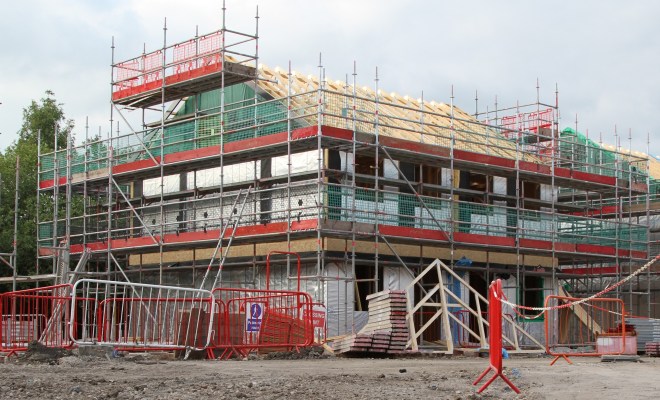
Sustainable building starts with ensuring structural integrity: a building built to last will reduce waste over the long term. Then we consider water tightness: many of the major problems in buildings today are due to water ingress or damp. A habitable space would also require ventilation (for good indoor air quality) and to follow building regulations and fire safety rules. Once these are achieved, we move on to reducing building heat loss through insulating sensibly. For a new build we can easily exceed the current building standards by specifying better and more insulation, superior low energy windows and doors to achieve best in class heat retention (building to Passive House, or PassivHaus, standards is also an attractive option these days that will seriously reduce the need for heating). For renovations, improving insulation is also easily achievable. External wall insulation is effective for older properties and internal wall insulation is a great option if the work is starting from the brickwork and needs new plasterboard anyway. Even if the job is simply to re-render an outside wall, adding a layer of external insulation as part of the project is a sensible and cost-effective addition. Whenever window frames are being changed or bought for new builds, it makes sense to specify improved energy ratings. Finally, consider heat pumps for heating: air-to-water heat pumps are excellent at giving low background heat using wet underfloor heating in new builds and air-to-air heat pumps can be fitted for space heating in many other properties.
In the middle of a building project it can be tempting to cut costs to stick to a budget. However, a clever budget could include the first 10 years or so of use (not just construction, but estimating the energy costs and maintenance costs for the building over a decade). Taking into account these ten year costs changes the choices we make: we select materials that will last longer, better insulation and better heating systems. In fact what we start doing is thinking of building as an investment with real returns.
Spending a little more upfront on insulation is a good case we can readily estimate.
Example: Windows
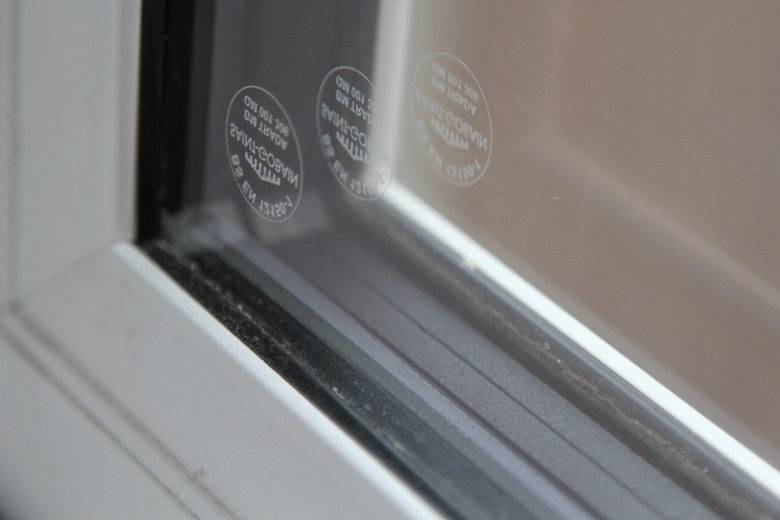
Selecting the best double glazing may cost around £10 more per square metre. Let’s say that gives us a U-value of 1.3 compared to 1.6. Is it worth it?
If we have 10 m2 of windows that means £100 more. The heat loss when it is 20°C inside and 0°C outside (a 20°C temperature difference) is equal to U × Area × 20°C. For the U = 1.6 windows that heat loss is 1.6 W/(m2K) × 10m2 × 20°C = 320 W and for the U = 1.3 windows that heat loss is 1.3 W/(m2K) × 10m2 × 20°C = 260 W. The improvement from using the better windows is a reduced heat loss of 60 W at these conditions. In the UK Midlands, roughly this can be translated to annual energy saving in kWh by multiplying by 4.8 (24 hours and 200 days equivalent) giving 288 kWh saving. If the heat were generated from a 90% efficient gas boiler then that’s a 320 kWh gas saving (288 / 0.9). With current gas prices of around 6p/kWh that is £19.20 saving per year.
So looked at over 10 years, it would be financially astute to specify the lower energy glazing system.
Triple glazing might also be an option. Triple glazing, surprisingly, does not cost massively more than double glazing as most use the same frames. A typical triple glazing system using gas-filled low E glass and warm edge spacers can achieve a U-value of 0.8. Using the same calculation as above, this could be a reduced heat loss of 160 W equivalent to an approximate annual energy saving of 768 kWh (for the UK Midlands) which would be a gas saving of 850 kWh with a good 90% efficient gas boiler (or 960 kWh with an older gas boiler of 80% efficiency). This is a £51 (or £58) annual saving. So triple glazing could repay nearly £500-£600 over a decade. The calculation could be modified into a net present value return on investment calculation, but probably the biggest unknown is what will happen to future gas prices.
So yes, it is often worth considering upgrading the windows when planning a building project.
A similar approach to the example above can be used for looking at the cost benefit for wall and roof insulation improvements. Being familiar with U-values and how to estimate them will improve your building project.
Moving from gas heating to electric heating with heat pumps is another great way to turn a building project into a green building project. Heat pumps will significantly reduce the amount of energy used as they make use of available heat in the air or ground and move it into the property (essentially paying for the energy needed to move the heat rather than paying for the heat taken from the heat source). The emissions benefit of upgrading to heat pumps is really worthwhile and cost improvements are easily achievable too. Choosing heat pumps will help future-proof a building project.
If that all sounds appealing then the final step might be to become an electricity generator by installing solar power on available roof space.
Build it better for the future!



See also
Insulation reference pages
Heat Pumps reference pages
Return on investment reference pages
 Living Laudato Si'