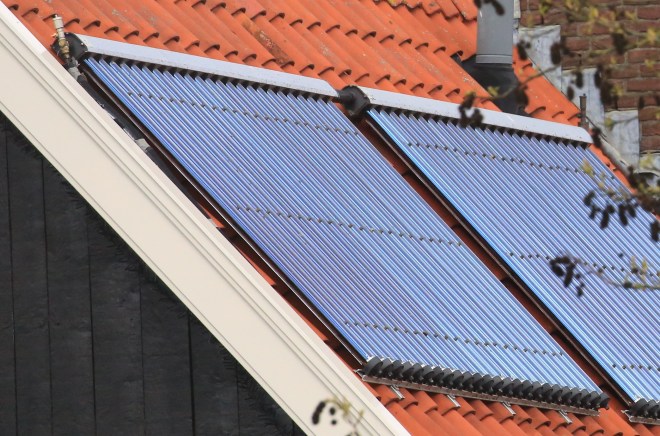
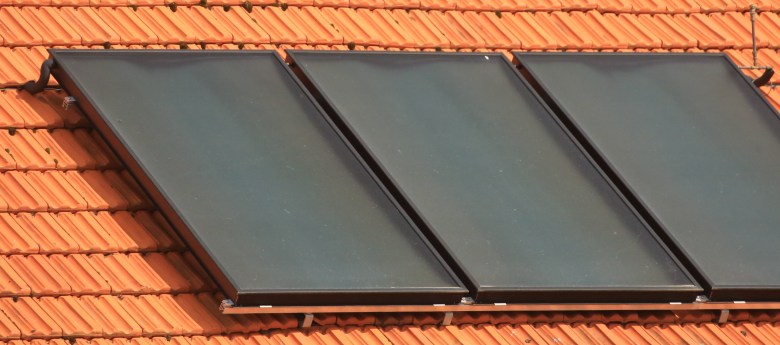
Whilst not as common as solar photovoltaic panels (solar PV), solar thermal panels have some useful advantages. The main benefit is that solar thermal panels are much more efficient at converting incident solar radiation into heat than photovoltaic panels are at converting it into electricity. This means that there is plentiful heat even in winter to provide a good amount of hot water. They are an effective way at decarbonising domestic hot water. For this reason, installations of solar thermal panels tend to be small, comprising only a a few panels.
Hybrid panels are solar thermal panels with solar photovoltaic panels on top, hence appearing as thicker PV panels. Hybrid panels may be integrated into the roof to make a flush roof surface which is very appealing aesthetically. Hybrid panels convert even more of the available incident solar radiation into useful energy (electricity and heat). A distinct advantage of these hybrid panels is that they perform very well in summer where the solar thermal layer provides cooling to the photovoltaic layer and this actually improves the efficiency of the conversion of light to electricity since in standard photovoltaic panels, the conversion efficiency reduces with increased panel temperature.
Hybrid panels may be a good match for schools where there is a fairly large demand for daytime hot water and electricity or for new-build housing where they are preferably integrated into the roof itself for only a small additional upfront cost.
If you have experience with solar thermal panels or with the more modern hybrid solar panels then let us know in the comments or by sending us some feedback on our contact page. We’re happy to provide more information on these panels to our readers from actual installations.

 Living Laudato Si'