Getting up-to-speed with electric vehicles
This page contains information that may be helpful to know prior to searching for an electric car. It is not a complete list and should be considered only as a start.
1. Driving Range
When the real world range is shorter than that we are currently used to we may be worried about getting to our destination or even getting to a charging point. This is worry is often termed range anxiety. An electric car is very likely to have a shorter range than an equivalent petrol or diesel vehicle. This means planning a long journey may well be more stressful. We may be aware that manufacturers of petrol and diesel vehicles got comfortable exaggerating the fuel efficiency claims in the last three decades. A genuine concern is whether these same manufacturers exaggerate the range of their new electric models. If it says there are 50 km remaining does that really mean 50 km or is it going to be used up in 10? What happens in winter? Do we have the same range? In an older petrol or diesel car, only a small percentage of the energy contained in the fuel actually is used to move the vehicle. This is because energy conversion process is fairly inefficient. A lot of heat is generated. In winter we find that some of this excess heat is rather useful for warming the passenger cabin and keeping the windows clear. So the fuel use increases a little but not too much. In an electric car we don’t have large wastage because the drive train is fairly efficient and a high percentage of the electrical energy does get used to move the vehicle. This means that in winter we will notice that to heat the car and clear the windows we will see the driving range reduce. Manufacturers have tried to minimise this reduction by using heat pumps rather than direct electrical heating, but we will still notice a range reduction. Driving style also has a big effect on real world range and this is likely to be more noticeable in an electric car. If you regularly push the speed limit on motorways you will notice a high consumption of range. It pays to drive smoothly and ease off the top speeds in order to conserve range.
The other range consideration is closely related to the battery capacity reduction discussed in section 4 below: as the maximum amount of charge stored in the battery reduces slightly over time, so will the maximum range. Manufacturer specifications almost always discuss range with a brand new vehicle. However what should concern most drivers is what the practical driving range is for an older car and whether any expected degradation is going to be minor. When new, the battery may be described as having 100% State of Health (SoH). As the battery gets old, this SoH can reduce somewhat. Modern electric cars have not been around for long enough to have their deterioration properly mapped-out and allowing comparisons between different batteries and models. However, to give a flavour of possible deterioration in battery capacity and driving range we suggest looking at this study. From the reported data, the more recent larger battery appears to be deteriorating slightly less after 3 years. In the absence of definitive data, it is probably best to check that you would be happy with 70% of the stated range as the vehicle ages.
Range and Efficiency
Efficiency is a measure of what you get out as a fraction of what you put in. For an electric car it is most easily expressed as miles or km of distance for 1 kWh of battery energy. The more efficient the car is, the further it can go on the same energy and so the higher the number, the better (very occasionally you might see the ratio expressed the other way round – energy over distance – so lower is better and this can be confusing so watch out). Efficiency is a useful measure because it helps us choose models that use less electricity (so there will be more green energy to share around) and of course is cheaper too. Range is slightly different: this is the furthest the car can get on a single charge. It is easy to see that an inefficient vehicle could get quite a distance if it has an enormous battery.
2. Emissions
An electric car is not emissions free. The point of emissions has shifted from the tailpipe to the power station. However due to the higher efficiency drive train we can expect that even if the power station uses fossil fuels, the overall greenhouse gas emissions will still be lower. Other emissions still continue from the brakes and tyres. Arguably the brake wear is reduced in most electric vehicles because, although vehicle weights are higher due to the heavy battery, regenerative braking is used in preference to friction brakes, so there is less wear on the pads and discs. Tyre wear, on the other hand, is increased as this largely depends on the vehicle weight.
Electric cars are clear winners when looking at urban air pollution in terms of oxides of nitrogen, unburnt hydrocarbons and carbon monoxide. Even modern petrol and diesel cars produce unpleasant exhaust fumes which are obvious on a cold winter day when people run their cold engines to defrost their vehicles. For this reason alone, switching to an electric vehicle seems to be a community-spirited action.
There are also what might be called hidden emissions associated with manufacture. These are released in the factories and supply chain (and the power stations that supply their electricity) for both conventional petrol and diesel cars as well as for electric cars. The manufacture of the large battery will have produced additional emissions. There will have been some savings since the electric drive train is simpler and obviously there would be no emissions associated with the manufacture of an internal combustion engine because there isn’t one.
Other emissions that are often ignored include the Well-To-Tank emissions and Transmission and Distribution emissions associated with getting the fuel to the forecourt or power station and getting the electricity to the charging point or factory.
The best way for reducing the emissions associated with an electric vehicle is to make sure it lasts longer!
3. Charging
Charging at home
If you are fortunate to have a driveway or garage then it is easy to have a domestic charger installed. These are A/C (alternating current) slow chargers which are perfect for overnight charging or to charge the car when it is not being used. Some energy companies will offer a reduced tariff if you tell them you have an electric car. You may also consider making use of off-peak electricity with a time-of-use tariff (for example “Economy 7” in the UK typically gives reduced rates from around midnight to seven in the morning although the start time for the cheaper electricity depends on the supplier and may be different in summer from winter). In the UK a charging point grant is available to reduce the cost of the charger and remember to ask your installer about this before you agree to go ahead. Other schemes may be available in other countries.
The other advantage of charging at home is that it is usually possible to defrost the vehicle using grid electricity when still connected just before the vehicle is needed in the morning. This helps a lot with range concerns in winter (discussed in section 1) and saves time and eliminates the early morning local pollution problem (discussed in section 2).
Future proofing your home charger
- Consider one which can be used with different connectors and cables in case you change your vehicle or have visitors
- If you are interested in future Vehicle-to-Grid opportunities then a compatible charger might be worth investigating. Vehicle-to-Grid (V2G) is a potential future way to loan your car battery to help with grid balancing and could be economically attractive. Grid balancing will be becoming more important with the increased amount of intermittent renewable generation on the grid. The traditional method of balancing using pumped storage does not have enough capacity, so more grid-attached storage is desired. Consumers could join in with allowing their home batteries to be managed and charged and discharged on demand. Vehicle-to-Grid extends this idea to the increasing fleet of connected battery electric vehicles. Although this article is not about V2G, the advantage of earning through this would need to be weighed against the possible disadvantage of increased battery cycling and risk of a little degradation in battery performance.
- If you have solar photovoltaic panels then you may wish to consider a charger which is also a “solar diverter”: when there is excess generation it will charge the car with that excess. This maximises the self-consumption of solar power and can be very useful for daytime charging in the summer. When clouds pass you can see the charge power drop off and rise as the sunlight brightens again. These smart chargers are also compatible with timed charging to make use of night time cheaper tariffs too. This option saves money and reduces the carbon intensity of the power used in the vehicle, reducing the overall emissions.
If you are unable to install your own charger because you rent or rely on on-street parking or a car park for overnight parking then the situation is less favourable. You may be reliant on your landlord, local council or local authority to provide the charging infrastructure or perhaps even a commercial charger in a public car park. Often this means that the attractive off-peak tariffs are not available and charging the electric vehicle becomes much more expensive. Furthermore overnight charging may be inconvenient and might not even be possible today. If you relate to this then you will probably agree that this is a social injustice that will need political engagement to resolve. Good landlords may be receptive to fitting a charge point so it is worth asking them first. Find out from your local council or local authority when charge points are due to be installed in your area or car park. Finally write to your representatives to argue that accessing cheaper tariffs when using overnight charging points is necessary and socially just. Good employers should provide discounted daytime charging for employees who don’t have access to overnight chargers.
Charging on the highway
Public charging can be a little stressful, whether in a city or on a long journey. Inevitably we worry whether we can find a charge point and, when we do, whether the charge point is compatible with our car and whether it works or we can use it (and don’t need to be a member of a club to use it). In the UK there is a handy App that tries to remove the stress from this and it is called ZapMap (their website is https://www.zap-map.com/ and https://www.zap-map.com/live/ to see the map). It lists nearby chargers and, although not infallible, gives an indication on what types they are, what their costs are and whether they work or not. What it doesn’t do is indicate how long the queue is for them when they are in use! Waiting is sometimes required at the popular motorway chargers. Clearly more charging infrastructure is needed.
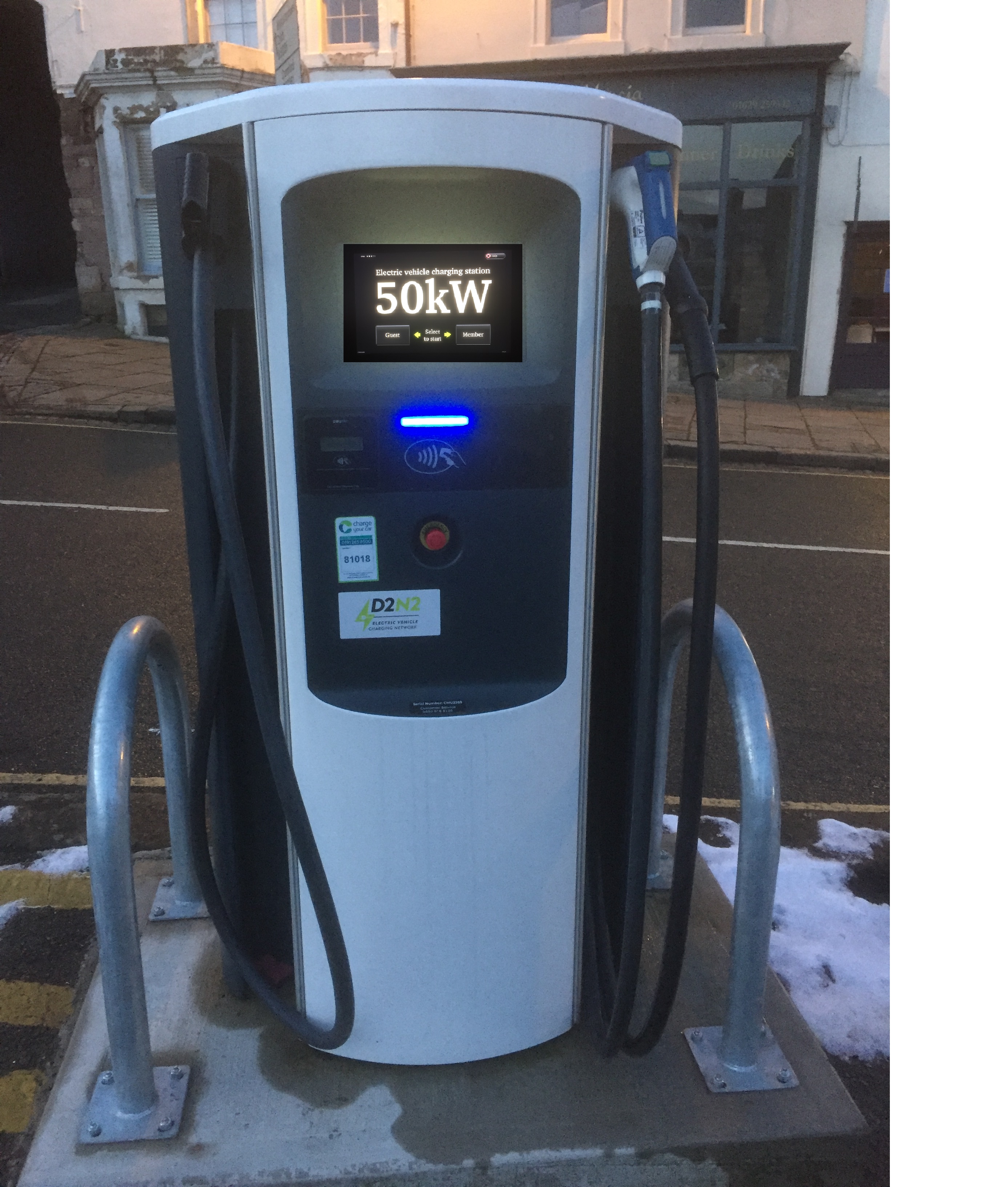
Highway chargers can be slower A/C chargers or faster D/C chargers (direct current). On a long journey you’ll probably want to find a fast charger so as not to hang around. Charging regularly using high speed D/C chargers will cost more and degrade the battery a little more over the long term (see next section). You’ll probably also want to stop the fast charging when you get to around 80% full because it is quicker (the last bit to 100% is often automatically slowed down to protect the battery) and is better for battery life.
Working charging out
To work out how much range you get in 1 hour charge, multiply the charger power in kW by 1 hour by the vehicle’s energy efficiency in miles per kWh or km/kWh. Here are some charging examples for a battery electric vehicle with a 75 kWh battery pack and an average efficiency of 3.5 miles per kWh (5.6 km/kWh):
| Charger | Range in 1 hour charge | Time to charge 52.5 kWh = 75 kWh battery 10% to 80% |
|---|---|---|
| 2.3 kW A/C domestic wall socket | 8 miles / 13 km | 22 hr 50 min |
| 3.6 kW A/C domestic charger | 13 miles / 20 km | 14 hr 35 min |
| 7.4 kW A/C single phase charger | 26 miles / 41 km | 7 hr 05 min |
| 22 kW A/C three phase charger | 77 miles / 123 km | 2 hr 25 min |
| 43 kW A/C commercial charger | 150 miles / 240 km | 1 hr 15 min |
| 50 kW D/C fast charger | 175 miles / 280 km | 1 hr 05 min |
| 100 kW D/C fast charger | 350 miles* / 560 km* | 0 hr 30 min |
Note that 3.5 miles per kWh (5.6 km/kWh) is a real measured example for a first generation mid-sized family battery electric vehicle measured over 4 years. You can see that, just like with petrol and diesel cars, getting a high efficiency electric vehicle is really important so we don’t waste energy. And here it also means you don’t hang around for longer waiting for charging too!
There are a number of websites for exploring more about connectors and charging. One aimed at UK readers that clearly shows the different charging connectors in use is this UK website.
4. Batteries and Ethics
An important observation from the International Energy Agency is that “[e]missions from minerals development do not negate the climate advantages of clean energy technologies” [1]. However there is a role for an aware consumer to make choices to improve emissions, sustainability and ethics in this sector. Laudato Si’ encourages us to do just that. “Education in environmental responsibility can encourage ways of acting which directly and significantly affect the world around us” (Laudato Si’, 211).
Battery types
Almost all pure electric vehicles use lithium-ion batteries. Hybrid vehicles may use lithium-ion or nickel metal hydride (NiMH) batteries. Nickel metal hydride have great longevity but don’t have enough energy density to provide attractive driving ranges in the same package size. The lithium-ion chemistries used are
- lithium cobalt oxide (LCO)
- lithium nickel manganese cobalt oxide (NMC)
- lithium iron phosphate (LFP)
- lithium manganese oxide (LMO)
- lithium nickel cobalt aluminium oxide (NCA)
Elements used and their origins
The metals popularly associated with electric car batteries are lithium and cobalt. Both of these have well-publicised sustainability and ethical challenges with their increased extraction. Accessible further reading is the IEA critical minerals report and is recommended.
Current and expected mineral usage in the IEA report is reproduced below [IEA (2021), The Role of Critical Minerals in Clean Energy Transitions, IEA, Paris https://www.iea.org/reports/the-role-of-critical-minerals-in-clean-energy-transitions, License: CC BY 4.0]
- Lithium – 20 kt (kilotonnes or thousand tonnes or million kg) used in 2020; current projections expect this to increase by 7.6 times in 2030 and 12.4 times in 2040; the scenario that meets the Paris Agreement goal of 1.5°C would need even more lithium: x18 in 2030 and x43 in 2040
- Nickel – 80 kt used in 2020; current projections expect this to increase by 8.1 times in 2030 and 11.9 times in 2040; the scenario that meets the Paris Agreement goal of 1.5°C would need even more nickel: x20 in 2030 and x41 in 2040
- Cobalt – 21 kt used in 2020; current projections expect this to increase by 5 times in 2030 and 6 times in 2040; the scenario that meets the Paris Agreement goal of 1.5°C would need even more cobalt: x12 in 2030 and x21 in 2040
- Manganese – 25 kt used in 2020; current projections expect this to increase by 4.1 times in 2030 and 4.7 times in 2040; the scenario that meets the Paris Agreement goal of 1.5°C would need even more manganese: x10 in 2030 and x16 in 2040
- Copper – 110 kt used in 2020; current projections expect this to increase by 6.5 times in 2030 and 8.6 times in 2040; the scenario that meets the Paris Agreement goal of 1.5°C would need even more copper: x15 in 2030 and x28 in 2040
- Graphite (carbon) – 141 kt used in 2020; current projections expect this to increase by 7.6 times in 2030 and stay similar at 7.3 times in 2040; the scenario that meets the Paris Agreement goal of 1.5°C would need even more graphite: x18 in 2030 and x25 in 2040
- Silicon – not used in significant quantity 2020; current projections expect this to increase to 26 kt by 2040; the scenario that meets the Paris Agreement goal of 1.5°C would need even more silicon: 90 kt in 2040
- Rare Earth Elements – up to 35 kt may be needed in 2040 to meet the Paris Agreement goal of 1.5°C
The countries associated with mining and refining of these minerals is shown in the IEA report and reproduced below

In the detailed version of the report there is also an assessment of which battery chemistries use which materials and compares their use to the minerals used in a conventional petrol or diesel car. It details the mineral usage of NCA, NMC, LFP and LMO chemistries. LMO (lithium manganese oxide) uses just over 200 kg of minerals for a 75 kWh battery pack, 100 kg of which is manganese but no cobalt. NMC (lithium nickel manganese cobalt oxide) batteries use around 180 kg but use more cobalt and lithium than the other three. NCA (lithium nickel cobalt aluminium oxide) batteries use around 160 kg with reduced cobalt. LFP (lithium iron phosphate) uses around 120 kg with no cobalt.
Ethical considerations for cobalt include the possible use of child labour and poor pay and conditions, in particular poor safety standards in some mines. Some lithium mining techniques where evaporation of salt brines is done in water scarce areas use up to 2000 cubic metres of water to extract a tonne of lithium and leaving toxic wastes behind (mine tailings). If 10 kg of lithium is in the car battery that means 20 cubic metres of water or 20 thousand litres of water may have been taken from a water scarce region for the lithium in that battery pack. What would be great would be the equivalent of a fair trade scheme for minerals – ensuring fair pay, good terms and conditions, responsible and sustainable mining practices. Repeatedly asking these questions of the car manufacturers may mean there is more scrutiny in the supply chains and ultimately standards could improve.
Battery manufacture
Battery manufacture regularly hits the headlines with the global race for “Giga-factories”. Battery manufacture is a complex process and production scrap is around 10%, contributing to waste [2]. These are large construction projects with large requirements for energy once operational. Locations that are suitably selected minimising biodiversity loss, with access to low carbon energy and with good transport links to the customer facilities are likely to be the more sustainable ones. Estimates for energy use are 50 to 65 kWh energy used per kWh battery capacity produced [3]. This allows an estimate of carbon footprint to be made if we know the carbon intensity of the local electricity grid. If the battery pack is 75 kWh then 3750 to 4875 kWh electricity was required to produce it. A coal grid would mean the battery manufacture released up to 4 tonnes of carbon dioxide emissions. Using local wind or nuclear power would represent equivalent carbon dioxide emissions of as low as 45 kg (perhaps 100 times less than coal). If the factory was plastered with solar panels then the equivalent value might be as low as 150 kg. So it matters where it was made and what energy was used by the factory. Live grid carbon intensities can be inspected at electricitymap.org.
Battery life, degradation and failure
Battery life depends on time, temperature and cycles. Battery cells can fail if they become too hot. Fortunately most car batteries have thermal management systems (or battery management systems) that monitor temperature and control cooling. Even so, electric cars in hot climates tend to have batteries that degrade more. Another way of exposing a battery to heat is through fast charging, which inevitably heats the cells more than standard domestic charging or overnight charging. The effect of fast charging on battery longevity will not be noticed if fast charging is used occasionally, but if this is the main way of charging then the charging cycles are likely to affect the battery life. For most lithium-ion battery chemistries, deep charging from near zero to full can contribute to degradation: on this point it is worth checking the vehicle manual to read what the recommendation is for looking after the specific battery in the vehicle (a few may recommend regular charging to 80% or limiting fast charging to 80%, for example). Keeping the state of charge high all the time may not be that great either, as may be regular topping up from say 80% to full [4]. Time also has an effect as the cells age. Many manufacturers now would suggest the battery should last between 15 and 20 years, perhaps more (by last they mean retain 70% of initial maximum capacity or driving range).
A concern often raised is that of battery failure. What is the risk of battery failure requiring replacement? Or even worse, what is the risk of battery fire? How does this compare with comparable failures in petrol and diesel cars? Taking the risk of fire first. Swedish authorities have compiled country statistics for electric vehicle fires [5] and because Sweden has been a good early adopter of electric vehicles this dataset should be a reasonably good comparison. In 2022 there were 4.98 million passenger cars in Sweden. Of this, 198 thousand electric cars and 413 thousand plug-in hybrids. There are around 3400 fires across all types of passenger vehicles each year, making a fire rate of 0.07%. For electric cars, there were 23 fires in 2022 (6 during the journey, 4 during charging and 13 other including those associated with other fire events). This makes the fire rate for pure electric passenger vehicles at 0.01% (previous years when the total electric fleet was smaller yielded fire rates around 0.03%: 0.02% in 2021, 0.04% in 2020, 0.02% in 2019 and 0.05% in 2018). Taken as a whole we can see that the fire rate for electric cars is consistently lower than that for all passenger cars of all fuels. The concern of elevated fire risk is not supported by data.
Data for battery failure is hard to come by, partly because it appears to be quite rare. Batteries are deemed to “fail” when their capacity drops to around 70% of stated maximum charge (or higher if the manufacturer guarantees higher). A recent study suggested battery replacement happens in 1.5% of vehicles and this is almost always covered by manufacturer guarantee [6]. Degradation (think range reduction) appears to be around 2.3% per year with the first year showing more degradation and in subsequent years the degradation tends to level off. Initial concerns of capacity degradation seems not to have materialised. Even initial predictions by manufacturers appears to have been pessimistic after real world data shows much lower levels of degradation. Incidentally, once a “failed” battery is removed it is likely to be used in a static application that does not need high performance, such as a battery to store excess solar power in a home.
End of life / recycling
A battery taken out of a car because it has degraded too much is still valuable to be used as a battery in a stationary power pack for grid balancing or storing excess solar power such as a domestic battery. The lower maximum capacity is not a problem for these because bigger sized batteries are fine in a battery enclosure on a wall or in a warehouse. Some companies specialise in re-using old electric vehicle batteries for these applications.
If a battery is not suitable for re-use then it could be recycled. Can old batteries be recycled? What percentage of batteries are recycled? What will happen in the future? It is fair to say that not many batteries so far have been recycled. Up until a few years ago it was generally estimated that around 5% of lithium-ion batteries (these are also used in phones and computers) were recycled. US domestic recycling rates were more like 15% [2]. The electric car market is fairly new and most large batteries produced are still in use. We also see a question on how much metal can be mined ethically and in an environmentally responsible manner. Prices of raw mineral ores are expected to rise as demand for batteries continues to grow. This will coincide with an increase in end-of-life batteries. The idea that metals could be extracted from old batteries more economically than from mineral ores has already been noticed. Research teams have been engaged on this for some time and the first commercial efforts on effective recycling have started. The expectation is that when the volume of batteries becomes larger then the process of recycling them will be in place. But economics could still force the wrong choice: if recycling still costs more than purchasing new ores in the future then we could end up with poor recycling rates in the future too. We will need political will to support recyclers move towards the 90% aim established by the US Department of Energy [2].
5. It matters where the electricity comes from
If you want your choice of electric car to be a force for good, then you really want to incentivise the construction of new renewables. The emissions from electricity generation can be reduced from the grid mix by providing a contractual demand for green electricity with green generators. Some energy suppliers help us do this with “deep green” contracts. Getting on one of these makes sure your money sends the right signal to the renewable developers.
Another approach is to flexibly charge your car and choose times to charge when there is lots of renewable power on the grid. This is easy to check with this website if you are based in the UK or France. Or look at your current grid carbon intensity at electricitymap.org.
Click here to see how to calculate the cost of an electric car.
Click here to see how to calculate the carbon dioxide emissions of an electric car.
[1] “The Role of Critical Minerals in Clean Energy Transitions”, IEA, Paris, 2021, https://www.iea.org/reports/the-role-of-critical-minerals-in-clean-energy-transitions
[2] Gaines L et al., “Direct Recycling R&D at the ReCell Center”. Recycling. 2021; 6(2):31. https://doi.org/10.3390/recycling6020031 available here
[3] Kurland S D, “Energy use for GWh-scale lithium-ion battery production”, IOP Publishing, Environmental Research Communications; 2(1):012001, December 2019, doi:10.1088/2515-7620/ab5e1e, https://dx.doi.org/10.1088/2515-7620/ab5e1e, available here
[4] Plug Life TV, accessible video on “Does charging your EV to 100% damage the battery?”, Plug Life Television Episode 4, available here. Also check out the channel here.
[5] “Sammanställning av bränder i elfordon och eltransportmedel år 2018–2022”, MSB, Sweden, April 2023. https://rib.msb.se/filer/pdf/29438.pdf
[6] “New Study: How Long Do Electric Car Batteries Last?”, article by Liz Najman, Recurrent, March 2023, https://www.recurrentauto.com/research/how-long-do-ev-batteries-last


 Living Laudato Si'