Sometimes we need a little inspiration to start. Sometimes we need to see that we have already started! Here we’ve collected a list of activities or ideas that help us move towards a sustainable future.
To make the list more approachable, we’ve divided up the ideas into three economic categories:
A saving tip – this will save us money today
Something small – this is an action that could cost a little money or time today but is a step forwards (some of these will save money in the shorter term)
An investment – this is an action for those who can make a bigger change (some of these will also save money long-term)
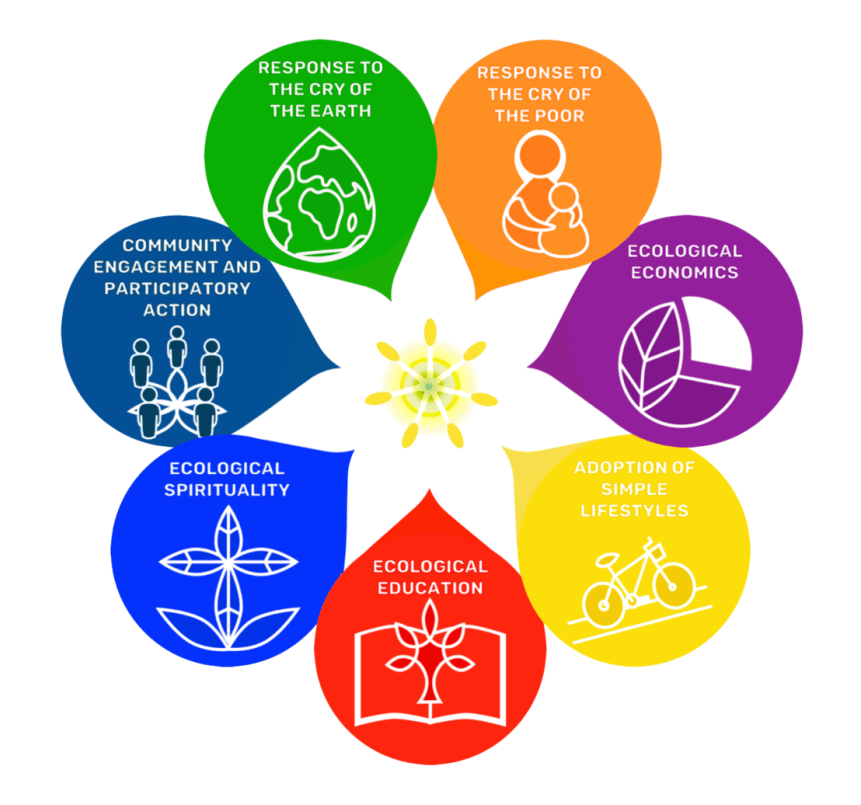
The 7 Laudato Si’ Goals
We’ve also tagged each idea with the Laudato Si’ goal that is most closely related to it. The seven Laudato Si’ goals are:
1. Response to the Cry of the Earth – examples are reducing fossil fuel use, net zero carbon efforts and renewable energy, protecting biodiversity and providing access to clean water.
2. Response to the Cry of the Poor – examples are protection of human life and all forms of life, caring for vulnerable groups such as migrants, children at risk and indigenous peoples.
3. Ecological Economics – examples are Fair-trade, ethical purchasing, sustainable production, investment in renewable energy and divestment from damaging economic activities including those responsible for pollution, fossil fuels and those that harm people and communities.
4. Adoption of Simple Lifestyles – examples are reduction in consumption, reduction of use of energy, reduction of waste, reduction in use of plastics, reduction in the amount of meat eaten, use of public transport and avoiding pollution.
5. Ecological Education – examples are creating ecological awareness and action through embedding integral ecology in educational courses and institutions and encouraging the ecological vocation for learners, teachers and leaders.
6. Ecological Spirituality – examples are renewing our spiritual life through a greater interaction with God’s created world, encouraging ecological conversion to a caring stewardship of the earth and bringing that focus into liturgical practice, prayer and retreats.
7. Community Engagement and Participatory Action – examples are advocacy and campaigning from the local level to the international level, hands-on awareness of the local environment and protection of local ecosystems.
See www.laudatosi.org for more information on the Laudato Si’ goals.
Why not make your own laundry detergent, bathroom cleaner and window cleaner yourself with simple and ecological ingredients (soap nuts, black soap, white vinegar, bicarbonate, etc.)?
Do you know that irrigating your plants during the heat of the day wastes water and could damage the plants? Some gardeners recommend the early morning.
Why not consider ethical investments for your savings and personal pension funds. If you have one, ask your independent financial advisor for ethical investment recommendations.
Ideas to help us on our journey to a sustainable lifestyle
We admit we’ve not tried all these ideas, but we have tried quite a few of them. The list will likely grow over time as more people share their inspirational stories with us. Every so often we will pick up an idea and blog about it to help understand how it can be done, how easy is it to implement, what the challenges are and how effective it is. On some we will pull together technical detail in a technical reference section and on others we will create educational resources.
Remember to follow our blog to keep up-to-date with our journey.
While they might be considered a little old, the encouraging words at the end of the movie “An Inconvenient Truth” (2006) still have some relevance today. These are the final words copied verbatim from the end of the movie…
"Are you ready to change the way you live?
The climate crisis can be solved.
Here's how to start
You can reduce your carbon emissions.
In fact you can even reduce your carbon emissions to zero
Buy energy efficient appliances + lightbulbs
Change your thermostat (and use clock thermostats)
To reduce energy for heating + cooling
Weatherize your house, increase insulation, get an energy audit
Recycle
If you can, buy a hybrid car
When you can, walk or ride a bicycle
Where you can, use light rail + mass transit
Tell your parents not to ruin the world that you will live in
If you are a parent, join with your children to save the world they will live in
Switch to renewable sources of energy
Call your power company to see if they offer green energy
If they don't, ask them why not
Vote for leaders who pledge to solve the crisis
Write to congress
If they don't listen, run for congress
Plant trees
Lots of trees
Speak up in your community
Call radio shows and write newspapers
Insist that America freeze CO2 emissions + join international efforts to stop global warming
Reduce our dependence on foreign oil
Help farmers grow alcohol fuels
Raise fuel economy standards
Require lower emissions from automobiles
If you believe in prayer, pray that people will find the strength to change
In the words of the old African proverb, when you pray, move your feet:
Encourage everyone you know to see this movie
Learn as much as you can about the climate crisis
Then put your knowledge into action."
Reduce-Reuse-Recycle
1. Reduce your energy usage: change lightbulbs, switch things off that are not needed, buy the most efficient appliances, only boil what’s needed, …
2. Reuse stuff: shopping bags, eliminate single use plastics and unnecessary packaging, compost vegetable peelings, …
3. Recycle what needs to be thrown. Buy recycled products too.
On the house, reduce your energy requirements: turn thermostats down, insulate sensibly, when you change windows and doors go for the best thermal efficiency options. Reduce your energy you buy in – use heat pumps not boilers, microgenerate your own energy (e.g. Solar). Buy green energy from dedicated green suppliers – those that actually encourage new renewables to be built.
On your personal transport, go battery electric or green hydrogen (if you can find it), plug-in hybrid is ok if you use the plug-in function regularly. It’s better of course to walk and cycle or take public transport.
On your purchases, go local and seasonal whenever possible and it’s cheaper too. On non-consumable goods, buy products that last longer. On tools and rarely-used equipment, offer to share or ask to borrow.
 Living Laudato Si'