
As we head towards another winter with the prospect of rising energy prices, are there simple things we can do for free or for relatively little cost to keep ourselves warm and cosy for less?
This is based on a post first published in 2021 and then updated in 2022 when energy prices soared. We’ve tried to incorporate the ones that make the most difference after having tried them ourselves. There are many ideas on the internet and in various guides on this topic. When trying something new, please take time to think about it and put your health first and, of course, make sure it is safe. If in any doubt, contact someone you trust to check it with them. Note that the information contained in this article is for educational purposes only. Consult a trusted professional before making changes to your specific heating setup.
Thank you to all those readers who have sent us through suggestions over the years. One important point to bring out is the necessity to keep the internal space and heating systems frost free at all times. When pipes or tanks freeze there can be serious and very costly impacts on the building structure so this must be avoided. A low level of background heat is often essential however we decide to keep warm. Finally, this guide is aimed at how to reduce energy use and not at comparing different energy deals out there. Do make sure you are on a competitive tariff if you wish to bring costs down on top of any energy saving measures you decide to implement.
Things I can do for free to reduce my gas bill today*
Heating
| If your home is quite hot then consider reducing the temperature you select on your thermostat. Read more here. |
| Wearing warmer clothing at home (more layers) may allow you to reduce the temperature too. Even a 1°C reduction brings considerable savings. |
| If you have room thermostats or TRVs (Thermostatic Radiator Valves) on each radiator, then consider lowering the temperature in the areas you don’t mind being colder – spare rooms, corridors, stairwells, toilets, kitchens and utility rooms. Read more here. |
| Keep internal doors closed, especially between areas of different temperatures. Read more here. |
| If your boiler is on continuous, consider changing settings for it to come on twice a day (people tend to like to have the morning timer set for just before you wake up and the evening timer for just as it is getting dark). This saves gas because it allows the temperature to fall a little when you are not likely to notice too much. Read more here. |
| If some doors or windows have draughts, consider putting some spare fabric along the gap to cut down the draught. Read more here. |
| Draw your curtains as soon as it gets dark. Curtains, especially lined curtains, can be very effective at reducing heat loss through windows. Remember to open curtains to benefit from solar heating in the daytime, especially if the sun is shining. |
| Keep your radiators clear of obstructions and clean. Furniture in front of radiators blocks their effectiveness as does stuff on top of them or blocking the fins behind them. If you have filters on your heaters then keep them clean and dust free. Read more here. |
| Check your loft insulation if you have a loft. If there are gaps or if the thickness is less than 270mm then you may qualify for free top-up insulation. Contact your energy company or look at the UK government advice website. If you don’t qualify for free help, it could still be worth improving your loft insulation to make more savings this winter. Read more here. |
Hot Water
| A shorter shower will not only save water, but save hot water (and reduce gas usage). For a similar reason, a shallow bath is better than a deep one. A short shower uses least energy (but be careful if you have a high flow power shower). Read more here. |
| If your hot water is scalding hot then reduce the temperature. 60°C is generally hot enough. Note that it’s important to make sure the temperature regularly gets above 50°C throughout the hot water system. Read more here. |
| If you have a timer on your hot water then consider once or twice on per day rather than continuous. Read more here. |
| Washing up under a running tap can quickly use up lots of hot water. Why not try using the plug and see if that works for you. |
Cooking
| Cook on the right size hob or burner (with a moderate or low flame that stays under the base) to reduce heat wastage up the side of the pan. Read more here. |
| If cooking on the hob, consider putting lids on pans wherever possible. This retains heat and moisture and reduces cooking time. Read more here. |
| If you have the tendency to pop out of the kitchen while you are cooking, consider staying with your food – you are less likely to overcook or burn food and waste gas in the process. |
| If you regularly heat up too much food and end up putting food back in the refrigerator, then heating up only the amount you need will save you time and money. |
General
If you are concerned about your gas usage and haven’t already got a smart meter, consider asking your energy company if they are installing them in your area. It would be installed for free and, although a meter doesn’t save money directly, if you keep an eye on the display it will help you spot the things you do that use more energy.
* here we assume gas is used for gas central heating, hot water and cooking
Things I can do for free to reduce my electricity bill today
| Turn off lights after you leave a room. Read more here. |
| Turn off electrical equipment. Standby power can consume quite a bit of electricity. Unplug chargers when they have finished charging. Read more here and here. |
| Boil only as much water as you need in the electric kettle (however keep above the minimum line as recommended). Filling with cup loads can help you boil exactly the right amount. Read more here. |
| Keep filters clean, including on high power equipment used occasionally such vacuum cleaners, cooker hoods and tumble drier filters. Read more here. |
| Run your appliances on Eco or energy saving mode wherever possible. Read more here. |
| Air drying clothes is the traditional way of drying before the tumble dryer arrived. Tumble dryers use large quantities of electricity. Read more here. |
| Run the washing machine and dishwasher with a full load so you don’t run them as often. Read more here. |
| If you like staring into the refrigerator or freezer, then remember that the unit has to do a lot of work to regain the correct temperature after you’ve closed the door. |
| Heating water electrically uses lots of energy and costs a lot. Wash your clothes at the lowest temperature you can get away with. Detergents can be fairly effective with cold washes. |
| Very rarely people find that they’ve had their immersion heater on by accident. Perhaps a child has switched it on, or you’ve forgotten to switch it off. As it is such a costly mistake it is worth just checking. |
| Finally have a walk round your rooms looking to see what is plugged in. You may be surprised what you find! |
What else can I do to reduce my gas bill which doesn’t cost too much and is relatively easy?
| Check your loft insulation. Missing or thin insulation is relatively cheap to correct and your energy company may be able to help you do this for free if you contact them. Note that if you have a water tank in your loft you must not insulate underneath it as this is the means for keeping it frost free by using the heat from the house – instead make sure it is insulated on top and around the sides. Insulate the overflow pipes from your tank to protect yourself from a water level issue in winter causing flooding. You can look at the UK government advice website here. |
| If you don’t have room thermostats or TRVs (Thermostatic Radiator Valves) on each radiator then getting them added gives you more control in each room. TRVs coupled with keeping doors closed helps you create zoned heating. Read more here. |
| Putting reflective thin insulation behind the radiators reduces the heat loss into the wall and so improves the heating of the room. Thin foil is good for high temperature radiators, foil backed with a thin layer of foam is better for lower temperature radiators. |
| If you have a hot water tank then make sure it is well insulated. The residual heat from a well-insulated hot water tank may be used to keep the water tank in the loft frost free (if you have a gravity fed system with a tank in the loft), so the more you insulate the hot water tank the more insulation should be on top of the loft tank too (remember no insulation under it). |
| Curtains aren’t as popular as they used to be but they can be pretty effective at trapping air at the windows and creating an insulating blanket over them. Lined curtains are better still. There are some curtain bargains to be found and some charity shops stock unwanted ones. Read more here. |
| Adding spare curtain material over an internal door can improve the ability to keep heat in a warm room. This may be useful if an internal door is separating zones of quite different temperatures. |
| Personalised heating was featured in a recent BBC article. It discussed hot meals, hot water bottles, electric blankets and wearing more layers of clothes. It also considered pre-heating your bed with a hot water bottle or an electric blanket prior to sleeping, judiciously placed blankets under your sleeping surface and using thicker duvets. Some of these are relatively inexpensive methods for feeling warm and snug in a colder house. |
What else can I do to reduce my electricity bill which doesn’t cost too much and is relatively easy?
| Make sure you are not still using old incandescent light bulbs. LED bulbs are bright, instantly on and ultra cheap to run. Have a look at the price comparison photo below. |
| Change halogen spot lights to LED bulbs. Most halogen spot lights are 50W and the equivalent brightness LED bulb is 7W – that’s a massive reduction. Read more here. |
| Using your vacuum cleaner on a lower power setting means you’ll have to empty it more regularly and keep it free from blockages which might take a little more time. |
| Plan ahead when using the oven. Maybe you can put two things in at the same time or one right after the other? Heat from the oven will generally heat the kitchen a little even once it is cooling down. Don’t be tempted to keep the oven door open as it is a safety risk and all the heat from the oven will go into the kitchen anyway even if the door is closed as it has to go somewhere even if it takes a little longer (unless you have an unusual externally-vented appliance). Keeping the oven heating for longer than needed is not generally cost effective. Note that most fan ovens will keep their fans running after the temperature setting is turned down to cool the heating element and protect it from breaking, so try not to switch off the appliance until the fans stop. |
| When you have to replace equipment, check the energy rating of the next appliance (whether you are buying new or used). Spending a bit more might be worth it with lower electricity bills. |
| If you use electricity during the night (or you could shift your usage) and your supplier offers a “time of use” tariff like Economy 7 or Economy 10, then this might save you money. You may need a Smart Meter to make the switch. |
The goal is to reduce your energy use. Units are measured in kWh – so look for the W rating of your equipment and lower is better – and keep your equipment off for longer to lower the number of hours h.
A note on ventilation. Although it is tempting to shut trickle vents on windows, having a minimum level of ventilation is really important, especially with higher levels of humidity inside homes from drying clothes, showers and cooking. Most modern homes probably need more ventilation in winter. A suitably-ventilated home is a healthier home. If you live in an old house with draughts everywhere then of course using draught excluders and cutting down on excessive air changes is going to help reduce your heating bills. Ventilating the kitchen more than other rooms is generally necessary especially if you cook with gas appliances or raise lots of steam and water vapour. Keeping the kitchen door closed and the kitchen cooler may help reduce bills and keep your home healthier.
Further tips
The Energy Saving Trust have tips to save energy. https://energysavingtrust.org.uk/energy-at-home/
They also have some information on how to reduce heat loss. https://energysavingtrust.org.uk/energy-at-home/reducing-home-heat-loss/
Another website we like is https://www.gov.uk/improve-energy-efficiency
Look how energy efficient products work
Running costs can be reduced significantly with energy efficient products. Prior to the latest price cap rise, a 100W bulb will cost £1 if left on for 38 hours (that is four and three-quarter days if it is on for around eight hours a day, using the October-December 2026 price cap). A CFL (compact fluorescent lamp) of the same brightness would cost only 19p for the same duration. A LED bulb of the same brightness would cost just 12p to run.

Unfortunately due to the rise in prices, that same 100W bulb will cost £1 if left on for 30.6 hours from January 2027 (that is just over three and three-quarter days if it is on for around eight hours a day, using the January-March 2027 price cap). A CFL (compact fluorescent lamp) of the same brightness would cost only 19p for the same duration. A LED bulb of the same brightness would cost just 12p to run.
What is the UK price rise going to be in January 2027?
Ofgem, the UK regulator, has published the price cap already.
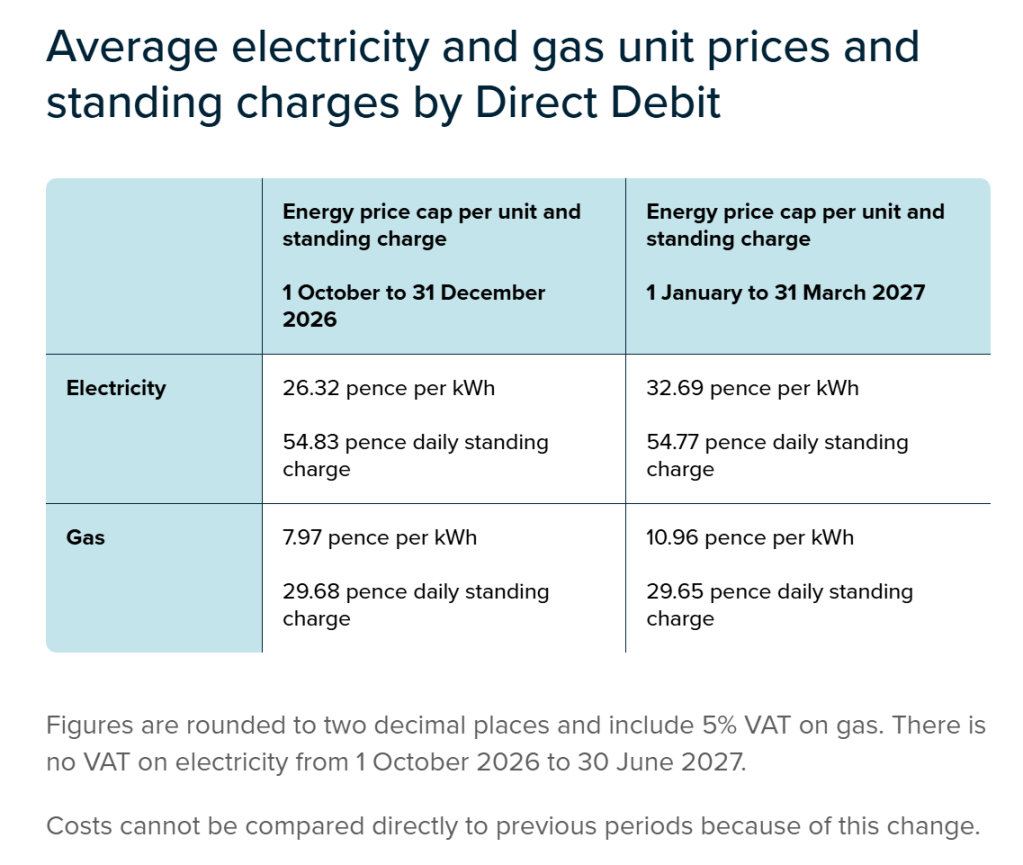
Unfortunately those on prepayment meters often have higher charges than those who pay by direct debit. Ofgem’s new price cap page details these towards the end of the page for those that are interested.
The energy saving required to keep bills the same as 2021 (when electricity was around £0.22 per kWh and gas was around £0.045 per kWh) in real terms (accounting for inflation) would be 15% reduction in electricity use and 48% reduction in gas use.
Looking at petrol or diesel use in our car?*
Things I can do for free to reduce my car fuel use today
| Leave your car at home for short trips if you are able to walk or cycle instead. Read more here or here. |
| Check you don’t have air conditioning switched on when you don’t need it. |
| Harsh acceleration will use more fuel. Read more here. |
| Driving in too low a gear uses more fuel. |
| Keep below or to the speed limits! Did you know that the fuel use goes up with the speed squared because of air resistance or drag? Incredible savings result from cruising at 60mph (100km/h) on the motorway compared to 80mph (130km/h). Read more here. |
| Look ahead. Think advanced driving. Gently easing off the accelerator when the light ahead is red means you gradually slow down and maybe by the time it goes green again you will be ready to gently progress without ever having stopped! Starting from still uses more fuel. |
| The drag of the car is increased by open windows. Keep them closed on the motorway. Use the ventilation to keep fresh air coming in instead. |
| Under-inflated tyres are not only dangerous, they give much more rolling resistance and push our fuel use up. Stick to the top end of the the manufacturer specified tyre pressures and check them regularly. |
| Keep your car regularly serviced to catch any issues with engine performance. |
| If you are stuck in traffic then consider the environment and switch your engine off. |
What else can I do to reduce my car fuel bill which doesn’t cost too much and is relatively easy?
| Tyre choice can have a big effect on fuel use. Consider tyre energy ratings when selecting new tyres – this might mean more expensive tyres at point of sale. Read more here. |
| Cover your car windscreen with a thermal blanket overnight to avoid ice scraping on winter mornings. Read more here. |
| Lift sharing might be an idea. If there is someone else going to the same place then why not get together? Read more here. |
| If your SatNav allows it, use an Eco routing rather than the default Fastest if you have time to do that. (In an electric car this might allow you to skip an intermediate recharging stop and so the Eco route could end up as a similar time anyway). |
| Remember to check the reviews and fuel economy when considering changing the car. Don’t forget to check for suitable electric cars as well. Read more here or here. |
* here we assume you have a petrol or diesel car. If you have an electric car you can still reduce your energy consumption with many of these ideas too.
The original 2021 article can be read here.
The updated 2022 article can be read here.

